

Spend enough time in SEO and you will eventually run an Ahrefs report on a competitor that outranks you in every keyword cluster you care about, then click into their backlink profile and see the same pattern: a steady, compounding curve of referring domains from real editorial sites with actual traffic. Not blog networks. Not article directories. Actual DR 50+ publishers with engaged readerships. Building that kind of profile is not a mystery — it is a sourcing and execution problem. The sourcing requires knowing which sites are worth targeting. The execution requires getting articles published on them that editors will actually accept. BestLinks AI addresses both sides of that problem as a fully managed service, handling everything from Ahrefs-based competitor analysis to per-site article writing and post-publish monitoring.
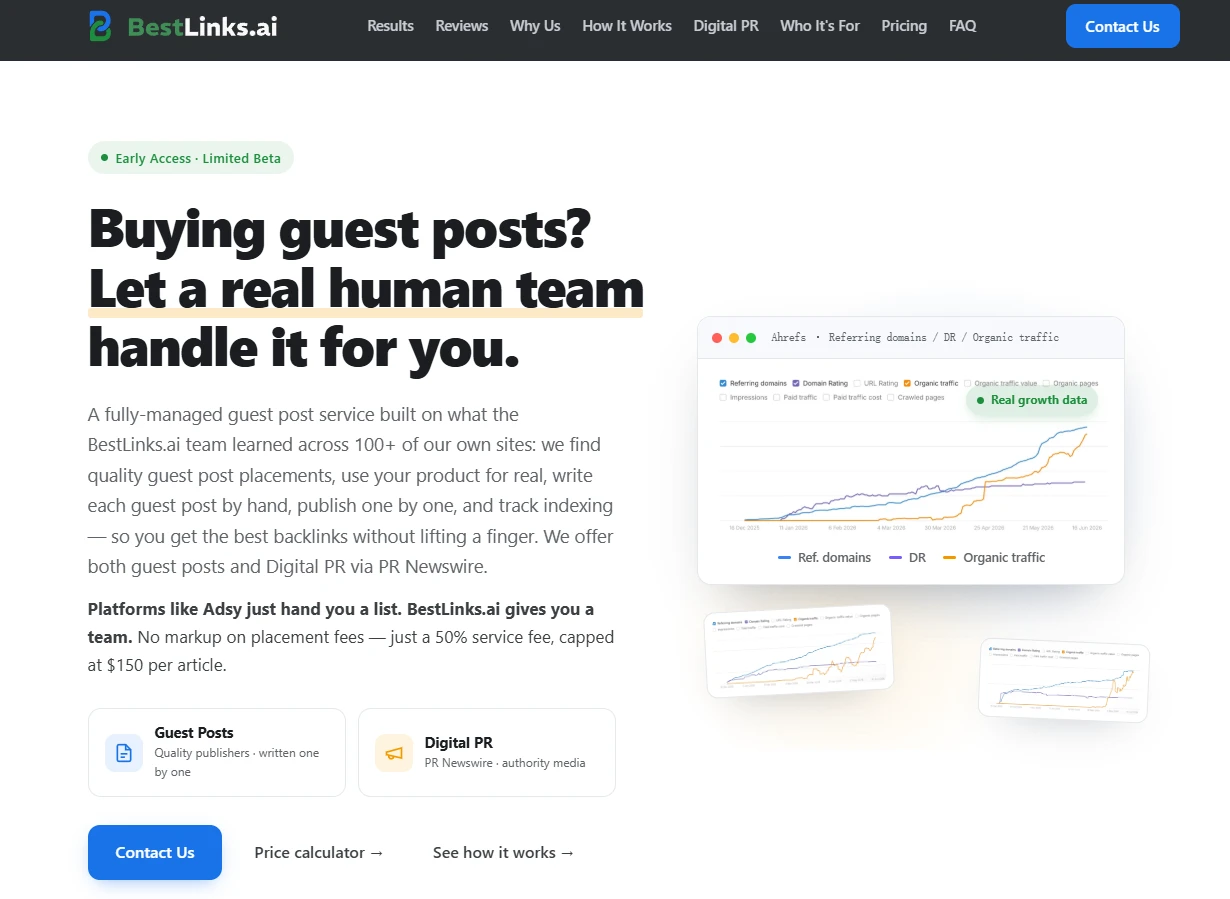
The service launched in limited early access after the team built and tested the same guest post acquisition process across more than 100 of their own niche sites. The homepage shows three Ahrefs growth charts from their own properties — referring domains rising first, DR following, then organic traffic — with an explicit note that these are for reference and not a guarantee of results. That context-setting is worth noting before going further.
A Service Built Around Competitor Backlink Intelligence
Step 1: Competitor Domains as the Starting Point
Prospecting is rooted in Ahrefs data, not a static publisher database
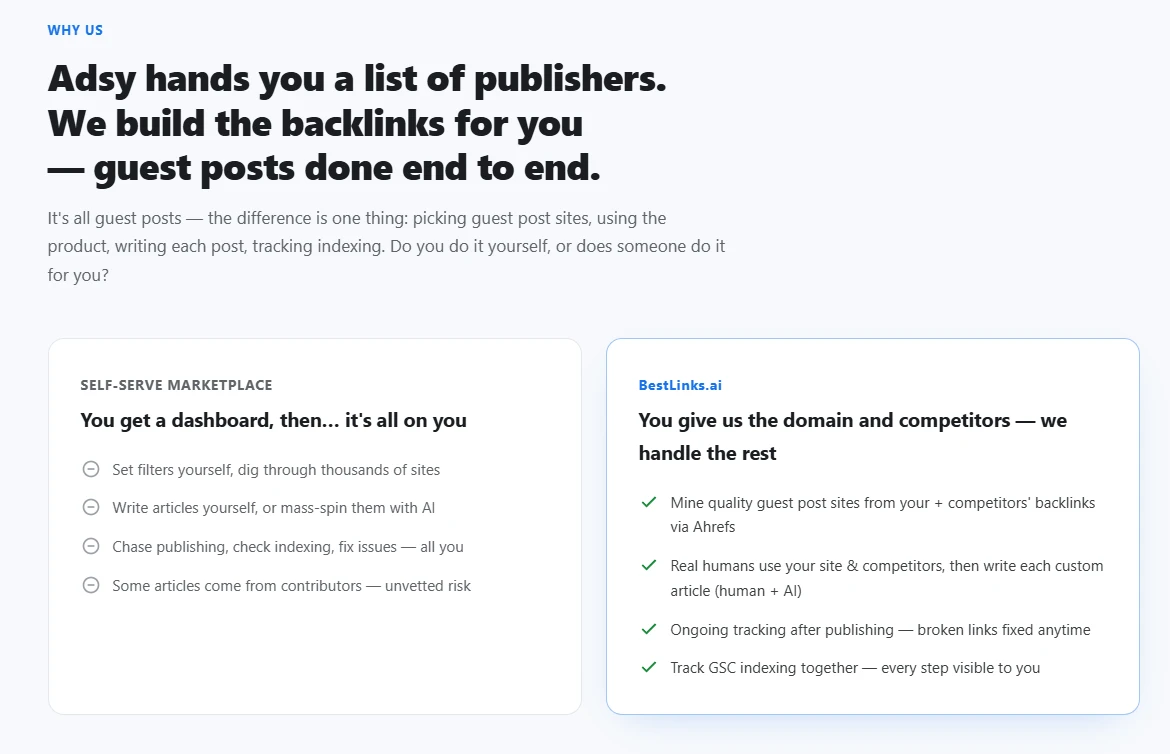
The intake process is minimal by design: one email with your domain and your main competitors. The team responds within 24 hours and creates a dedicated communication channel. From there, they run your competitor domains through Ahrefs to surface the guest post sites that have already been willing to publish in your space — filtered for Domain Rating, organic traffic, and cost. The shortlist they send back contains that data in visible form, so you are not evaluating publisher names blind.
Step 2: You Select, They Write and Place
Article production is separated from publisher selection, kept per-site
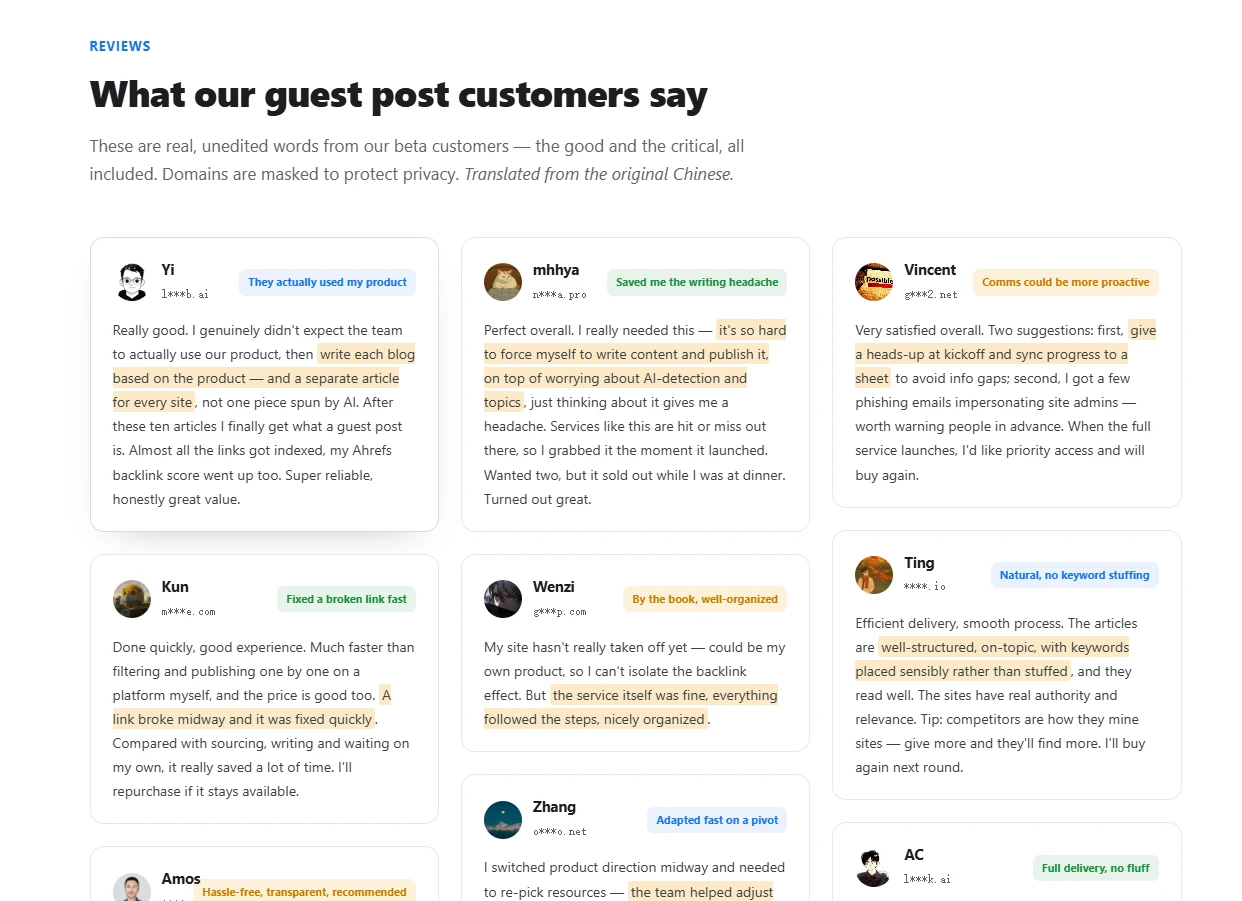
After you choose which publishers from the shortlist to target, the team writes a distinct article for each one. They use your product and your competitors' products directly before writing, which is the stated basis for the editorial approach. Each article is written for its specific target site rather than adapted from a master template. The team describes this as human-led with AI assistance — a relevant distinction because pure AI-generated guest posts have an increasingly visible quality signature that editorial sites are catching. The Guest Post output is reviewed and placed by real people, not auto-submitted.
Step 3: Publish Monitoring and Indexing Transparency
GSC indexing status is tracked collaboratively, not handed off and forgotten
Each article publishes individually. Broken links are fixed at any point after publication without additional charges. You are asked to note which links appear indexed in Google Search Console and share that back with the team — this creates a feedback loop that keeps indexing data shared between both sides throughout the engagement. It is a simple mechanism, but most self-serve platforms have no equivalent.
How the Sourcing Method Differs From Marketplace Models
The structural difference between a publisher marketplace and a managed competitor-research model is not subtle. On a self-serve marketplace, you see a list of publishers who have opted in to sell links. That pool is, by definition, full of sites that are actively monetizing their editorial section — which is a selection pressure that tends to attract sites publishing at high volume for the income rather than for audience value.
The Ahrefs-based sourcing approach starts from a different pool: sites that have already chosen to publish guest content in your topic area because of editorial relevance, not because they are registered link sellers. Whether a given site from that pool is worth targeting still depends on DR, traffic, and the specific article it would receive — but the starting population is meaningfully different.
|
Dimension |
Marketplace Self-Serve |
Competitor Ahrefs Mining |
|
Publisher pool |
Opted-in link sellers |
Sites that already published in your niche |
|
Filtering method |
You configure filters |
Team filters by DR, traffic, price |
|
Editorial reputation risk |
Higher — volume-driven sites |
Lower — editorially motivated sites |
|
Discovery time |
Hours of manual filtering |
Delegated to team |
|
Overlap with competitors |
Possible duplication |
Surfaced deliberately |
|
Negotiation required |
Sometimes |
Handled by team |
Pricing Structure: Where the Fee Cap Changes the Math
The service fee is set at 50% of the placement cost, with a minimum of $15 and a maximum of $150 per article. Placement cost — what the publisher charges — is passed through with little to no markup. The team is explicit that they do not generate margin on the placement side, only on the service fee.
In context: the standard managed guest post industry model charges a 100% service fee on placement, meaning a $100 placement costs $200 total. Under this fee structure, that same placement costs $150 total — $100 placement plus $50 service fee. On a $300 placement, the service fee would calculate to $150, which is exactly where the cap sits. Anything above $300 in placement fees carries a flat $150 service charge regardless of how high the placement price goes. For operators targeting high-DR editorial sites that command premium placement fees, that cap has a compounding effect across a campaign.
Clients placing 50 or more articles can inquire directly about pricing beyond the published rate structure.
Honest Constraints Before Any Decision
English is the only supported language. This is not a soft limitation — the team refunded at least one beta participant who needed non-English placements. If your SEO targets are in non-English search markets, this service does not apply to your current needs.
The service is explicitly not designed for pre-revenue sites. The team states this as a qualification condition: if your site is not yet earning, they recommend waiting. The reasoning is implied but sensible — guest post backlinks accelerate an existing trajectory, they do not create one from nothing.
Because this is an early-access service with limited capacity, onboarding is not guaranteed regardless of budget. In my reading of the homepage, the team is managing intake carefully rather than scaling indiscriminately.
On the results side: the Ahrefs charts shown are from the team's own properties under conditions they managed end to end. The service fee and placement fees are fixed inputs; the DR growth and traffic outcomes are functions of your site, your content, your keyword strategy, and the competitive landscape in your niche. The team labels the charts as reference examples, which is the accurate framing.
Matching the Service to the Right Stage of an SEO Program
The operators who extract the most value here are running a content-led site or product with established revenue who want Ahrefs-quality publisher sourcing without building an in-house link acquisition function. The one-on-one channel, the competitor-intelligence sourcing, and the post-publish monitoring are each designed to reduce the operator's active time without removing their visibility into the process.
For anyone in an earlier stage — still validating monetization, needing non-English coverage, or wanting a dashboard-driven self-serve experience — this is not the right fit at this time. For operators at the right stage, the combination of competitor-derived publisher sourcing, separate per-site article production, and a capped service fee structure makes it worth the conversation.


