If you’ve ever said any of these out loud (or in your head), this article is for you:
-
“I practice every day, but I still don’t sound good.”
-
“I know the chords… why can’t I play songs cleanly?”
-
“I’ve been playing for years, but I feel stuck.”
-
“YouTube lessons help, but something’s missing.”
Here’s the uncomfortable truth most guitarists don’t hear early enough:
Time spent practicing guitar does NOT equal progress
How you practice matters far more than how long you practice.
And most guitarists—beginners and intermediates alike—develop bad habits early that quietly sabotage their progress for years.
In this deep-dive guide, we’ll break down 7 extremely common guitar practice habits that look productive on the surface but are actually slowing you down. For each one, I’ll show you:
-
Why it hurts your progress
-
What’s really happening under the hood
-
Exactly how to fix it (practically, not theoretically)
This article is optimized for players who want to learn guitar online, practice smarter, and finally feel real momentum again.
Let’s fix your guitar practice—starting today.
Habit #1: Practicing Without a Clear Goal
What this looks like
You pick up the guitar and:
-
Play a few chords
-
Run through the same scale
-
Noodle around
-
Maybe attempt a song
-
Put the guitar down
Sound familiar?
This is unstructured practice, and it’s the #1 reason people feel like they’re “practicing but not improving.”
Why this kills progress
Your brain learns through specific problem-solving, not repetition alone.
When you practice without a goal:
-
You reinforce what you already know
-
You avoid weak areas unconsciously
-
You confuse familiarity with improvement
Neuroscience backs this up: skill acquisition requires intentional focus on errors, not mindless repetition.

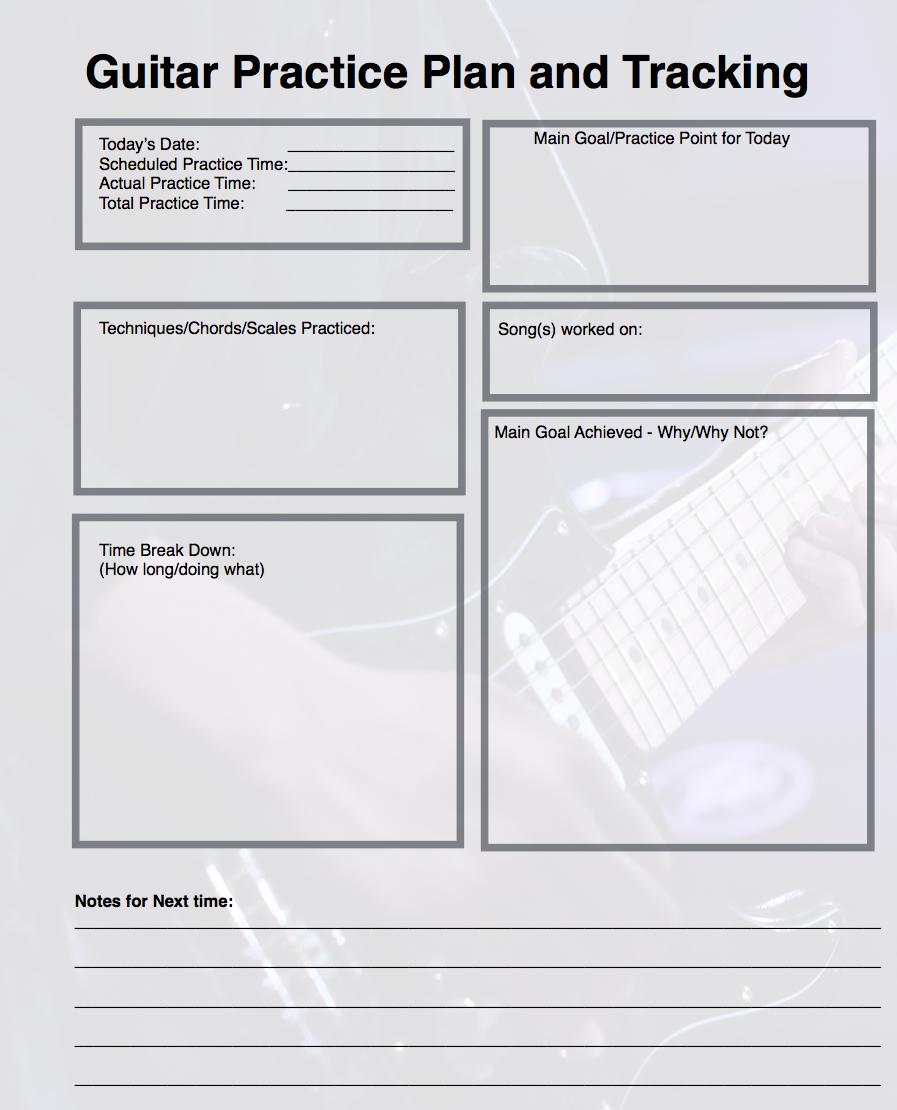
The fix: Micro-goals
Instead of “I’ll practice guitar for 1 hour,” try:
-
“I’ll clean up chord transitions between G and D”
-
“I’ll fix string noise in this bar”
-
“I’ll lock this riff to a metronome at 70 BPM”
One session = one main goal.
This single shift instantly upgrades your guitar practice quality.
Habit #2: Always Playing at Full Speed

What this looks like
You try to play:
-
Songs at original tempo
-
Riffs as fast as possible
-
Solos at performance speed
And when it falls apart… you just try again at the same speed.
Why this kills progress
Speed hides problems.
Slowness reveals them.
When you practice too fast:
-
Mistakes become habits
-
Timing errors go unnoticed
-
Your hands panic instead of learn
Muscle memory does not know “almost correct.” It only knows repeated movement patterns—good or bad.
The fix: Painfully slow practice
Here’s the rule pros live by:
If you can’t play it perfectly slow, you can’t play it fast.
How to apply this:
-
Use a metronome
-
Start at a speed where you cannot mess up
-
Increase tempo in 5 BPM increments only
Yes, it feels boring.
Yes, it works ridiculously well.
This single guitar practice tip fixes more problems than most players realize.
Habit #3: Repeating Mistakes Instead of Fixing Them
What this looks like
You mess up a phrase and think:
-
“I’ll get it next time”
-
“Close enough”
-
“It’ll clean up eventually”
Then you repeat the section… with the same mistake.
Why this kills progress
Every repetition strengthens neural pathways—even wrong ones.
Practicing mistakes is like:
-
Typing the wrong password repeatedly and expecting access
-
Driving the wrong route and hoping to arrive correctly
Your brain doesn’t self-correct without intervention.
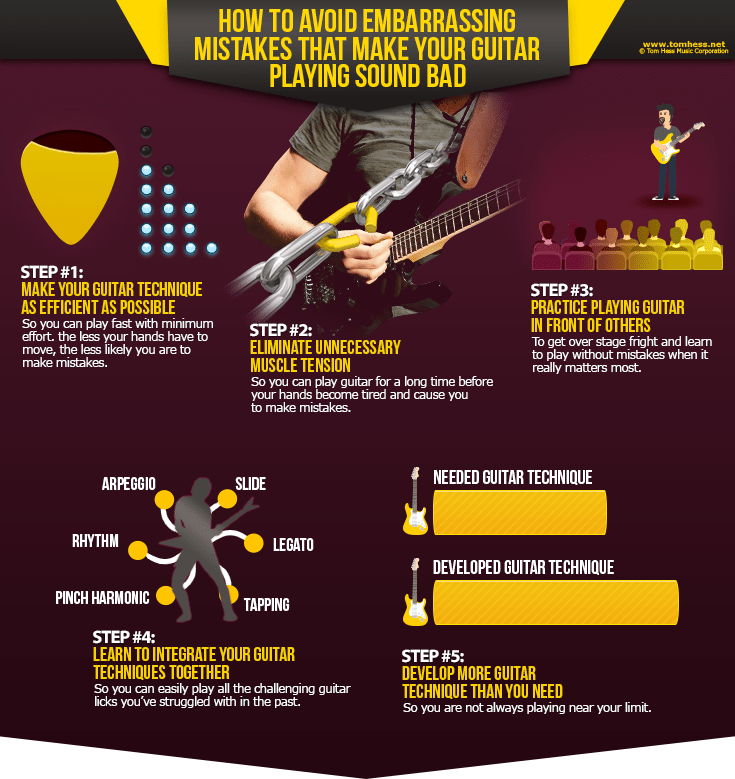
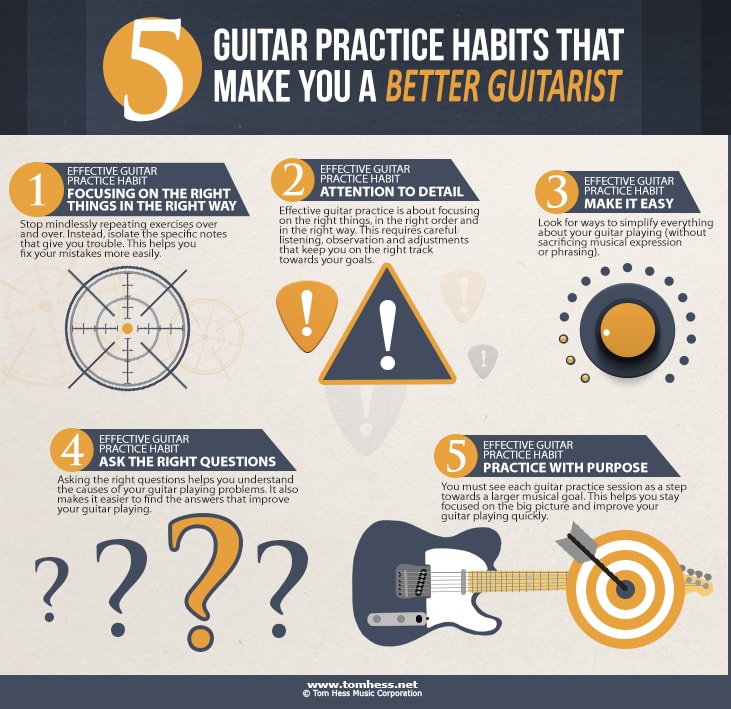
The fix: Isolate → Diagnose → Rebuild
When a mistake appears:
-
Stop immediately
-
Identify the exact issue (timing, fingering, tension, picking angle)
-
Isolate just 1–2 notes
-
Rebuild slowly and correctly
-
Reinsert into the phrase
This feels slower, but it multiplies learning speed.
Elite guitarists don’t practice more—they practice cleaner.
Habit #4: Ignoring Rhythm and Timing

What this looks like
-
You focus on notes, not rhythm
-
You skip counting
-
You “feel” the timing instead of measuring it
-
You avoid metronomes
Why this kills progress
Timing is the difference between sounding amateur and musical.
You can:
-
Miss notes and still sound musical
-
Play wrong notes rhythmically and still groove
But perfect notes with bad timing?
Always sounds wrong.
The fix: Rhythm-first practice

Try this:
-
Clap the rhythm before playing it
-
Count out loud
-
Practice muted strings for rhythm only
-
Use a metronome on beats 2 & 4
If you want to truly learn guitar online effectively, rhythm training is non-negotiable.
Habit #5: Only Practicing What You’re Already Good At


What this looks like
You:
-
Play favorite licks
-
Avoid weak techniques
-
Skip uncomfortable chords
-
Stay in your comfort zone
It feels good… and it feels productive.
It’s not.
Why this kills progress
Progress lives just outside comfort.
If your practice feels easy:
-
You’re reinforcing old skills
-
Not building new ones
-
Not expanding ability
The fix: Discomfort budgeting
Structure your guitar practice like this:
-
40% comfortable material
-
40% challenging material
-
20% new/unfamiliar material
If you’re not slightly frustrated during practice, you’re probably not growing.
Habit #6: Learning Randomly Instead of Systematically

What this looks like
-
Jumping between YouTube videos
-
Learning isolated tricks
-
No clear path or sequence
-
No idea what to learn next
Why this kills progress
Random learning creates:
-
Knowledge gaps
-
Technique imbalance
-
Confusion and overwhelm
You end up knowing many things shallowly instead of a few things deeply.
The fix: Structured learning paths
Whether you learn guitar online or offline, you need:
-
A progression-based curriculum
-
Skills that build on each other
-
Clear milestones
Random inspiration is great.
Random structure is not.
Habit #7: Measuring Practice by Time, Not Results
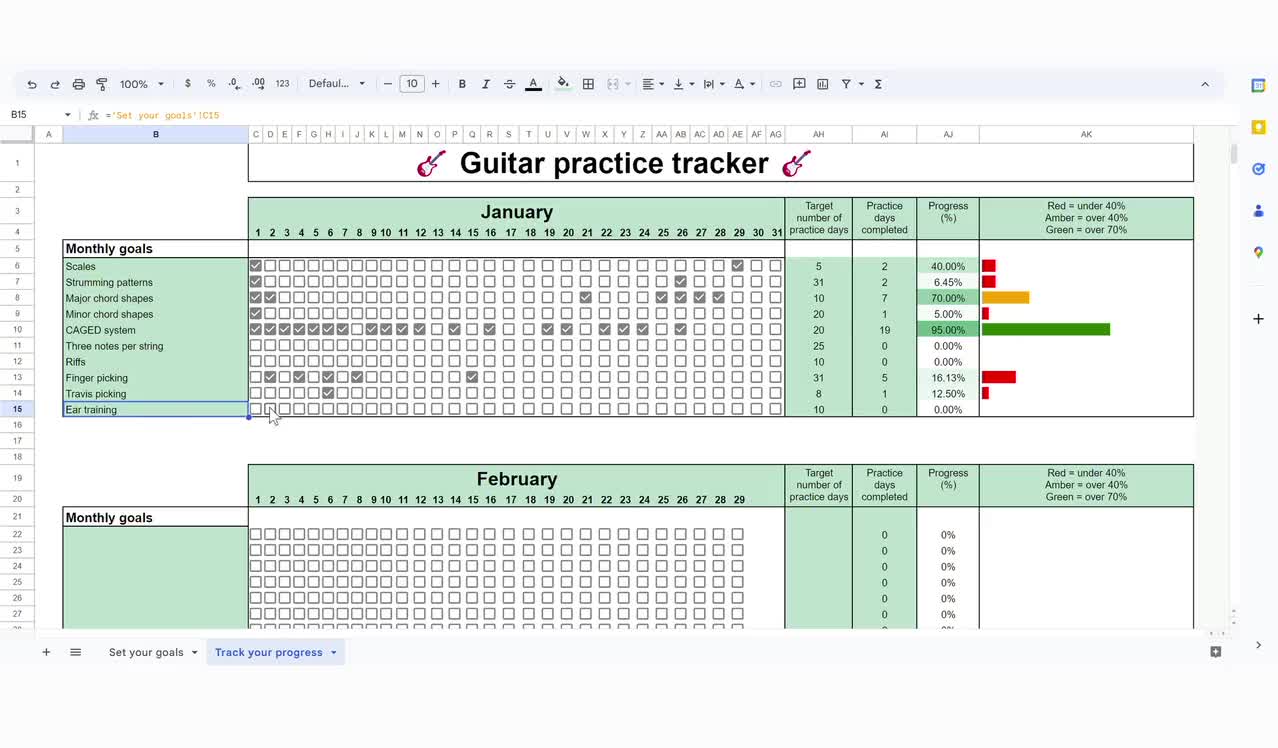
What this looks like
“I practiced for 2 hours today.”
But:
-
What improved?
-
What changed?
-
What’s better than yesterday?
Why this kills progress
Time is not a performance metric.
Results are.
Long, unfocused sessions often underperform short, intense ones.
The fix: Outcome-based tracking
After every session, ask:
-
What improved today?
-
What still needs work?
-
What’s tomorrow’s goal?
Even 20 minutes of focused guitar practice beats 2 hours of autopilot playing.
A Smarter Way to Practice Guitar (Quick Framework)
Use this simple structure:
-
Warm-up (5 min)
-
One technical focus (10–15 min)
-
One musical application (10–15 min)
-
Review + reflection (5 min)
This aligns perfectly with how the brain actually learns motor skills.
Frequently Asked Questions (FAQ)
How long should I practice guitar every day?
Consistency beats duration.
30–60 minutes of focused guitar practice is ideal for most players.
Is it okay to learn guitar online only?
Absolutely—if the learning path is structured. Random videos alone slow progress.
Why do I feel stuck even after years of playing?
Usually due to:
-
Practicing mistakes
-
Avoiding weak areas
-
No feedback loop
-
No clear goals
Fixing practice habits unlocks progress fast.
Should beginners use a metronome?
Yes—earlier than most think. Timing habits form early and are hard to undo later.
What’s the fastest way to improve on guitar?
Not speed.
Slow, focused, intentional practice with clear goals.
Final Thought (Read This Twice)
Most guitarists don’t fail because they lack talent.
They fail because they were never taught how to practice guitar properly.
Fix these 7 habits, and you’ll feel something rare:
-
Control
-
Clarity
-
Confidence
-
Real progress
Author bio: